THE END OF ROMANCE
Text Publishing, 2026.
A captivating dystopian masterpiece. For fans of Charlotte Wood and Cormac McCarthy.
It is the future, and the earth has seemingly refused to cooperate with humanity, producing only thorn-bearing plants and caustic fogs in abundance. Life is hard for those who still inhabit urban communities. For those who have chosen to live ‘off-grid’ it is subsistence at best, but at least there is some kind of independence.
A woman and her son live alone, surviving as scavengers. Even so, the boy must attend military school like all the other boys. In time he will be shipped off with the rest of them to a distant planet – the Promised Land – to fight the colonising war that is touted as humanity’s only hope.
By chance, the woman meets a young man who has avoided this fate, despite his lack of physical impairment. It appears that he comes from a place of sanctuary. Can he lead her back there – and help her to save her son?
In taut, evocative prose, Maria Takolander has conjured an eerie and compelling story of desolation and hope that resonates in the imagination.
‘Enigmatic, surprising and inventive. I couldn’t put it down.’—Carrie Tiffany
Radio & podcasts
Maria Takolander in conversation about The End of Romance. Interview with Nico Callaghan, The Readings podcast.
Discussion of The End of Romance. Presented by Kate Evans and Cassie McCullagh, ABC Radio National The Bookshelf.
Maria Takolander in conversation about The End of Romance. Interview with Claire Nichols, ABC Radio National The Book Show.
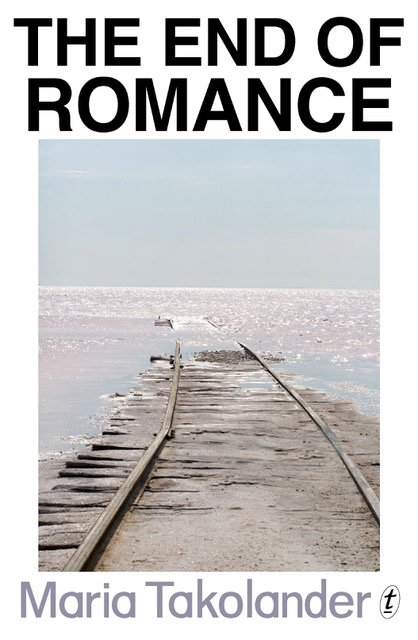
Available for purchase here.
Honours
Assisted by an Australia Council ‘New Work’ grant.
Assisted by a Neilma Sidney Travel Fund award.
Assisted by an Arteles Creative Centre residency.
Assisted by a Foundation for Australian Literary Studies and Australian Institute of Marine Science residency.
Reviews
‘Here, in all its glory, is the intense poetic imagination of Maria Takolander . . . Suspense is a key ingredient . . . this novel is compelling and chilling as it sings its way towards its resolution.’—The Age, Sydney Morning Herald, Brisbane Times, WA Today.
‘The [characters’] journey through the wastelands quickly takes on allegorical qualities, redolent of the fictions of JM Coetzee and Cormac McCarthy . . . This is a tense, engrossing and deeply uncomfortable novel that speaks in urgent tones to our complacent moment.’—The Guardian.
‘The End of Romance is a fascinating and brutal novel . . . [Takolander’s] affinity for poetry comes through in her fiction writing, which is beautiful and compelling. This book is pleasurable to read, visual and intricate, and despite the suffering that the characters go through, I enjoyed travelling through this strange future world . . . I suspect everyone who reads it will have a different opinion . . . on the characters, their motives, and on the logics of the society itself.’—Readings.
‘A haunting literary dystopia that asks what remains of love, family and meaning when the stories we've built our civilisation upon begin to unravel.’—The Readings Podcast.
‘The End of Romance is told in four sections. Each offers a different perspective on the future and is written in its own unique style, demonstrating Takolander’s range and depth . . . Takolander’s writing is bare-boned here, though moments of beauty still shine.’—The Conversation, ArtsHub, Big News Network, shethepeople.tv, aol.co.uk
‘There is something deliciously generative about the juxtaposition of Muskian fantasies of space exploration and ecological and social breakdown. Not only does the idea of troops being sent to fight wars of colonial conquest in space evoke the classic texts that so many of our tech bro overlords cite as inspirations—Starship Troopers, anyone?—it also subtly invokes the anti-colonial, anti-militaristic counter-tradition found in works such as Ursula K Le Guin’s The Word for World is Forest . . . lets us see our world in new and different ways.’—The Saturday Paper.
‘Prize-winning poet Maria Takolander’s first novel is set in a fog-bound, discombobulating dystopia . . . [The characters] set off on a Road-like journey of survival, but is there sanctuary at journey’s end?’—The Age, Sydney Morning Herald, Brisbane Times, WA Today.
‘Takolander’s background as a poet is evident in her prose, which brings this disturbing setting to life . . . asking what gives life meaning under oppressive conditions. It will appeal to readers of Claire Moleta’s Unsheltered, Margaret Atwood’s The Handmaid’s Tale and Charlotte Wood’s The Natural Way of Things.’—Books+Publishing.
‘True-blue page-turner.’—New Idea.
‘Fascinating . . . strange and beautiful and a bit poetic all at the same time.’—ABC Radio National, The Bookshelf.
‘Will remind readers of the father-son odyssey in Cormac McCarthy’s 2009 novel The Road . . . [though] Takolander casts the relationships between the people on this decaying Earth in a different light . . . what happens is unexpected.’—Australian Book Review.